Mirabai Chanu's Asian Games Silver: Winning by Lifting Less
Mirabai Chanu won Asian Games silver with a lower total than the one that left her fourth in Paris. The difference was not strength. It was staying fit.

On 23 September 2026, in Nagoya, Saikhom Mirabai Chanu won silver in the women's 49 kg weightlifting at the Asian Games. She lifted 87 kg in the snatch and 111 kg in the clean and jerk, a total of 198 kg. Ri Song-gum of North Korea took gold with 215 kg, breaking three world records, and Luluk Diana Tri Wijayana of Indonesia took bronze with 191 kg.
It was Chanu's first Asian Games medal, and India's first weightlifting medal at the Games since Karnam Malleswari in 1998. She is 32. She already owned an Olympic silver from Tokyo, a 2017 world title, three Commonwealth Games golds and a former clean and jerk world record of 119 kg. The Asian Games was the one major podium that had eluded her.
Look at her three biggest recent competitions and something unusual appears. At Tokyo 2020 she lifted 202 kg and won silver. At Paris 2024 she lifted 199 kg and finished fourth, missing her last clean and jerk at 114 kg. In Nagoya she lifted 198 kg, less than both, and won a medal.
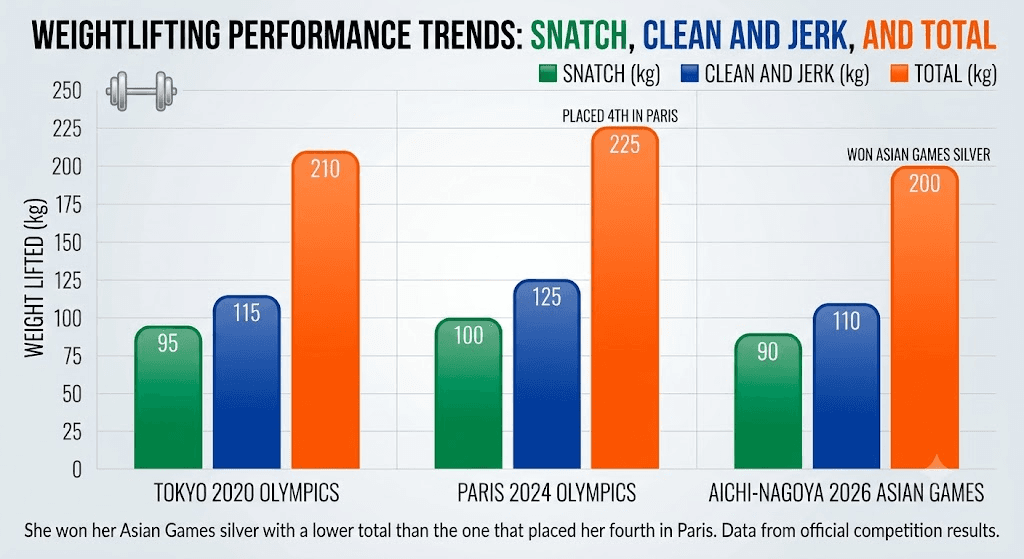
One honest caveat. China, which usually dominates this weight class, did not send lifters to Nagoya. In Paris three women finished ahead of 199 kg; in Nagoya only one finished ahead of 198 kg. The field matters. But a weaker field only rewards the lifter who turns up healthy, and Chanu had either missed or been injured at two of her previous three Asian Games.
That quality has a name in sports medicine: availability, the share of time an athlete is healthy enough to train and compete fully. It rarely makes headlines, yet it decides more careers than raw talent does. Chanu's career is one of the clearest illustrations of it.
At the Rio Olympics in 2016 she failed to record a total, completing only one of her six lifts. A year later she was world champion. She missed the 2018 Asian Games through injury. At the 2023 Games in Hangzhou she was carried from the platform after a failed 117 kg clean and jerk, and did not compete again for six months. Her coach, Vijay Sharma, later said the team had not seen that injury coming; she had felt some discomfort in the warm-up, but not enough to pull out.

She has always been candid about her technical weakness. The snatch, in which the bar travels from the floor to overhead in a single movement, has been her weaker lift. Before Tokyo she said she felt more comfortable and confident in the clean and jerk, and that her snatch technique was not good enough to let her go heavier. The record agrees: her best competition snatches have sat between 85 and 88 kg since 2017, while her clean and jerk reached a world record of 119 kg in 2021.
In 2020, with her shoulder and back causing persistent pain, Chanu and Sharma travelled to St. Louis to see Aaron Horschig, an American physiotherapist and former competitive weightlifter. By then she could lift only about half of her normal training load.
Here the published accounts disagree. The evaluation attributed to Horschig, reported in the Hindustan Times, lists instability and weakness in the right shoulder, restricted movement in the left shoulder, poor mobility and stability in the left hip, and back pain. In an interview with The Tribune from St. Louis, Chanu described it the other way round: her left shoulder was weak and was overloading her right shoulder and back.
An athlete's summary of a medical assessment is not the assessment itself, so we treat the clinician's list as the more reliable source. What both versions agree on matters more than the side: weakness on one side of the body, stiffness on the other, producing pain and a reduced ability to handle heavy loads.
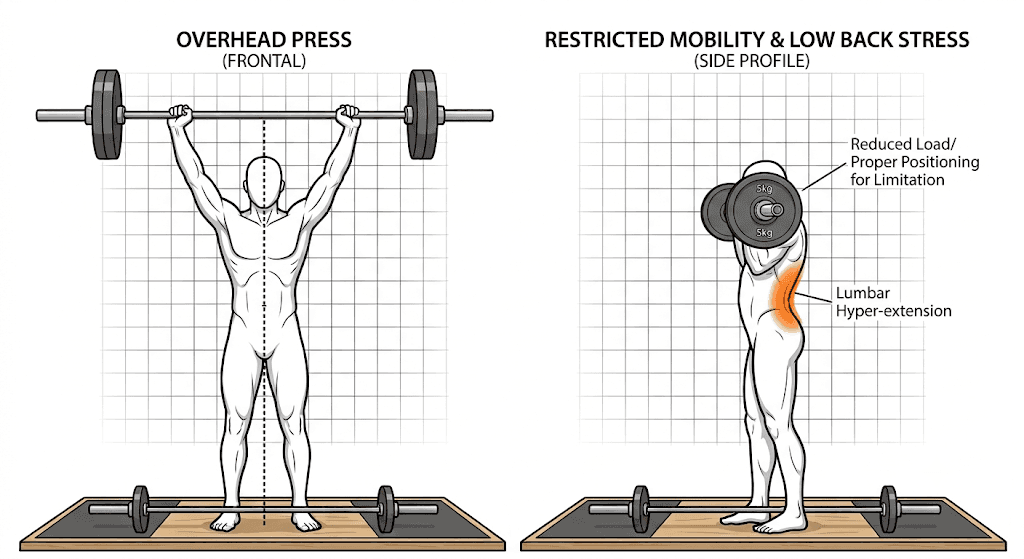
Weightlifting shows why that combination causes trouble. The snatch and the jerk need the bar held steady directly overhead. The clean needs it resting on the front of the shoulders with the elbows high, which demands a great deal of shoulder and wrist movement. When a joint cannot reach the required position, the lifter still completes the lift by borrowing movement from neighbouring joints and shifting load onto them. This is called compensation. It works, until the structures doing the extra work become overloaded and painful.
The response was quick. After about three weeks of corrective exercise and conditioning, Chanu told The Tribune she was pain-free and back to around 85% of her previous training loads. According to Sharma, Horschig identified the problems within hours of watching her train, not from the medical reports they had brought. Chanu pointed to a change in how she trained: a heavy day followed by a light day, with shoulder and back rehabilitation built into every session rather than added at the end.
The recovery from her 2023 injury is the better documented of the two, and the more instructive.
For five months after Hangzhou she trained only her upper body and general conditioning, with no leg work at all. When she returned to St. Louis in January 2024, Horschig told ESPN she could not squat more than 80 kg without severe pain in her right hip. This was an athlete who had previously squatted 150 kg for more than ten repetitions. His assessment found a small imbalance on the right side that was overloading parts of the leg, and treatment focused on correcting it and improving how well her gluteal muscles engaged.
She then rebuilt from the beginning: squats with no weight, then an empty bar, then gradually more. Five months later she was squatting 135 kg for repetitions. Coaches and physiotherapists call this graded reloading: returning load in steps small enough that the tissue adapts rather than breaks down. A few weeks later she lifted 199 kg in Paris.

It is tempting to turn a story like this into a set of rules. Three ideas come out of it, and they deserve different levels of confidence.
Stiffness on one side creates overload elsewhere. Well supported. When one joint cannot move fully, neighbouring joints make up the difference and take more strain.
A strength difference between left and right predicts injury. Not well supported, and often overstated. Many clinics use a 10% or 15% difference between sides as a warning sign, but studies have not consistently shown that such differences predict who gets hurt. In Chanu's case the imbalance explained pain she already had. That is a sound use of the finding. Using it to forecast a future injury is a different claim.
At the top level, staying healthy matters more than peak strength. This is the lasting lesson. Chanu's best total is 202 kg, and she won her Asian Games medal with 198 kg. The four kilograms were never the problem. The two six-month absences were.
What anyone can take from her approach is the order of operations:
Watch the athlete move instead of relying on scans alone.
Find out which side is stiff and which is weak.
Treat the stiffness, not just the painful spot.
Bring load back gradually, starting below the level that causes pain.
Review it week by week, not only before competitions.
None of these steps is new. Doing them consistently for six years, through two serious injuries and across two continents, is what is rare.


This article is for education and does not replace individual medical advice.
No peer-reviewed case report on this athlete's rehabilitation exists, so this article draws on published interviews and official results. Where accounts conflict, the text says so.
Mirabai's shoulder on the mend. The Tribune, 12 November 2020. Interview with Chanu from St. Louis.
Weak shoulder, aching back: how Mirabai Chanu was fixed in USA. Hindustan Times, 2021. Reported evaluation findings and an interview with coach Vijay Sharma.
Mirabai Chanu's path to a second Olympic medal. ESPN, 2024. Horschig's account of the right hip imbalance and the rehabilitation after the 2023 Asian Games.
Official competition results: Tokyo 2020, Paris 2024 and the 2026 Aichi-Nagoya Asian Games.
North Korea's Ri breaks world records en route to third Asian Games gold. Reuters via The Star, 23 September 2026.
Asian Games 2026: Lifter Mirabai Chanu ends India's 28-year-old wait. The Week, 23 September 2026. Source for the absence of Chinese lifters.
Other Blogs

Strength Testing in Chennai: The Vital Insights Protocol

