Strength Testing in Chennai: The Vital Insights Protocol
Eleven force-plate and dynamometer tests, compared to your age, sex and weight, turned into a three-month plan and a retest. Here is how it works.
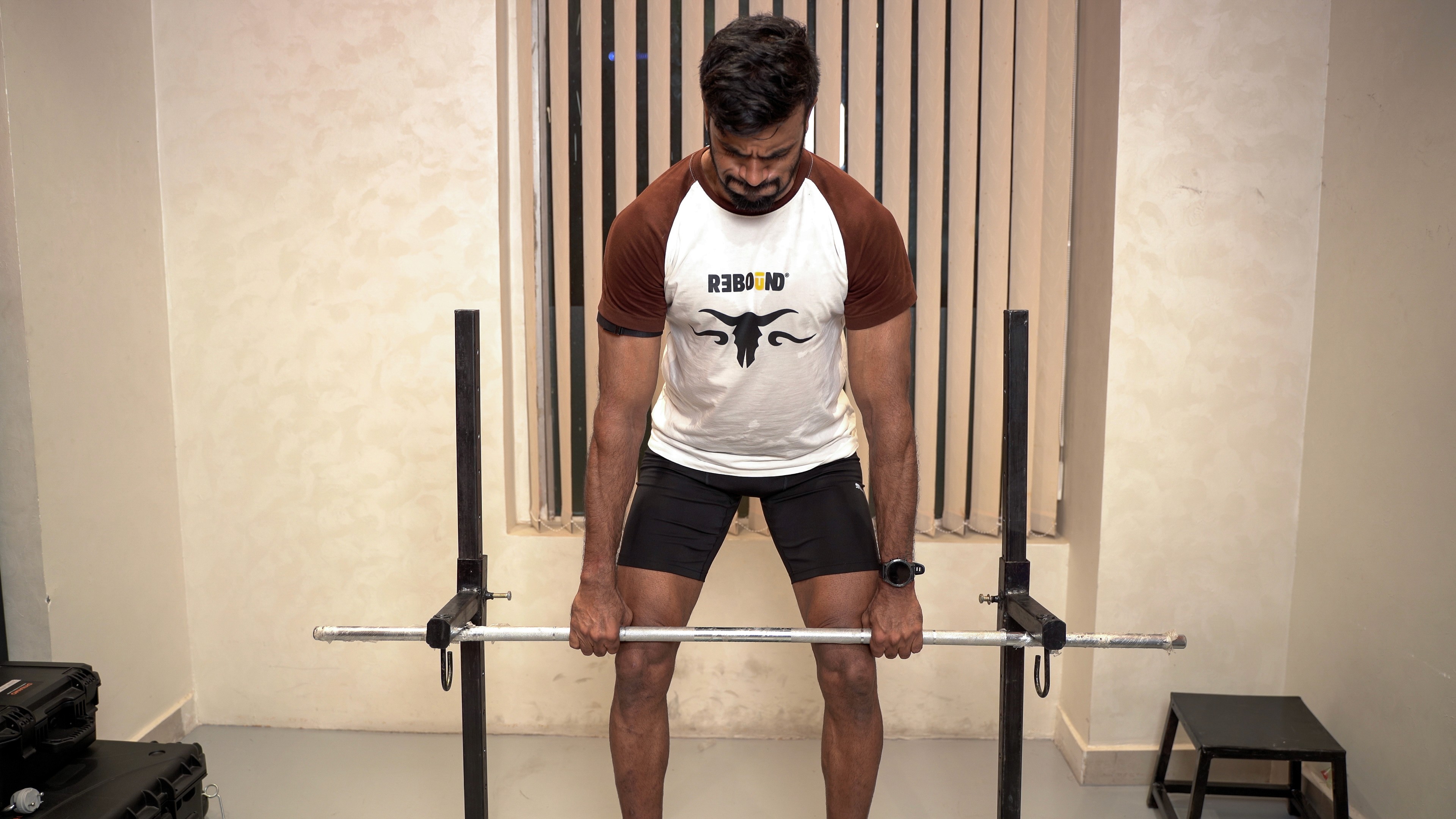
Ask most people how strong they are and they will quote a number from the gym: a bench press, a squat, a deadlift. That number is shaped by technique, confidence, fatigue, equipment and how much risk the person was willing to take that day. It also cannot tell you which side of the body did the work.
We take a different approach. Using dual force plates and a handheld dynamometer with a built-in inclinometer, we measure the force each muscle group actually produces, in newtons, recorded hundreds of times per second. The result is not an estimate of strength but a direct measurement of it.
Strength Lite is our full eleven-test battery. It covers the upper body, the lower body and the body working as a whole.

Strength Pro adds a DEXA scan to the same eleven tests, which changes what the results can tell you. More on that below.
Every result is compared against normative values for your age, sex and body weight, because the same number means very different things for different people. We also ask about your training background (new, returning or currently active), because that decides how quickly a plan can progress. On top of the individual tests, we report three strength ratios that describe the balance between opposing muscle groups: shoulder external to internal rotation, hip adduction to abduction, and hamstrings to quadriceps.
Hand grip may look like the least sporting test in the battery. It is also one of the most studied measurements in all of medicine.
The PURE study followed 139,691 adults in 17 countries for a median of four years. Every 5 kg of weaker grip was linked to a 16% higher risk of death from any cause and a 17% higher risk of death from heart disease. The pattern held for men and women, young and old, rich and poor countries alike. Grip strength predicted death from any cause and from heart disease better than systolic blood pressure did.

Two cautions keep this in perspective. PURE is observational, so grip is best read as a window onto overall physical robustness, not something to train for its own sake. And most grip reference values come from Western populations. Indian datasets exist but are smaller, so the exact percentile for an Indian adult carries more uncertainty than the decimal places suggest. We would rather say that than hide it.
Reaching your maximum force takes about 300 milliseconds. A sprinter's foot is on the ground for about 100 milliseconds. When you catch your toe on a step, you have roughly the same time to stop yourself falling. In both cases, what decides the outcome is not your peak strength but how much force you produce before the moment has passed.
That quantity is called rate of force development: how steeply force rises in the first fraction of a second of a contraction. Two people can have identical maximum strength and very different rates of force development, and in real movement the faster one often wins.
This matters most for three groups:
Older adults rely on early force to stop a fall. Once the body has tipped past the feet, peak strength is almost irrelevant.
Athletes in sprinting, jumping and change-of-direction sports spend most of their time inside that early window.
People recovering from injury show a specific pattern: after knee ligament (ACL) reconstruction, maximum strength can return well before the speed of force production does.

That gap has real consequences. A patient can clear the usual return-to-sport benchmark on maximum strength, commonly 90% of the uninjured leg, while still falling short on the quality that governs landing and stopping. A test that measures only maximum strength will pass that patient.
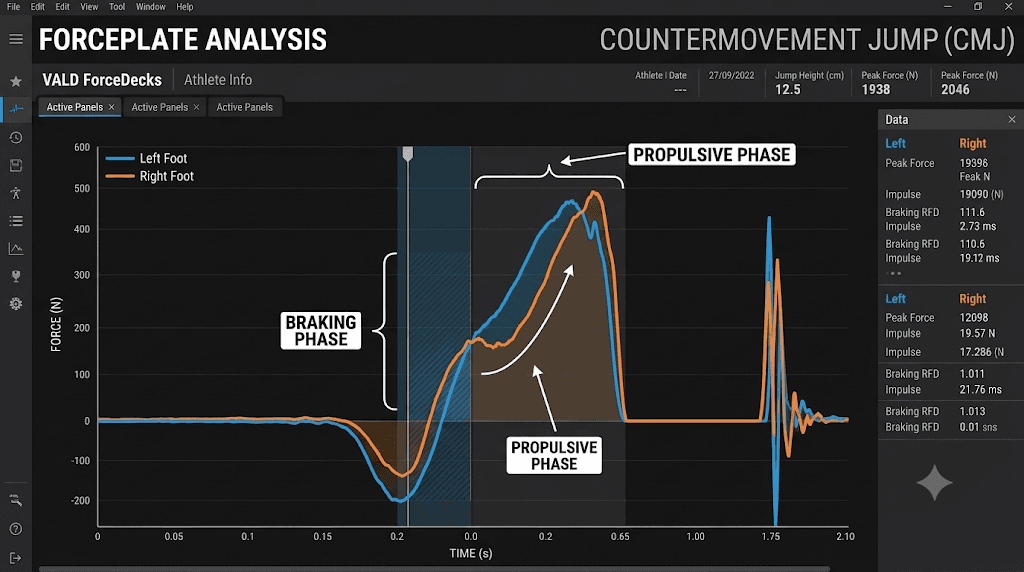
On dual force plates, a countermovement jump becomes far more than a height. Each foot is recorded separately, so we see how force is shared between the legs. We can separate the eccentric braking phase, when the body dips and the muscles absorb load as they lengthen, from the propulsive phase that drives you upward.
Jump height turns out to be the least informative number the test produces. It can stay the same while the way you achieve it changes, for example a longer, slower dip that hides a loss of force. Those changes in timing and shape show up before height drops, which is why they are used to track fatigue and recovery.
The isometric mid-thigh pull does a different job. You pull against a fixed bar in a strong, upright position, and the plates record the maximum force your whole body can generate. It is safe, quick and repeatable without a heavy bar on your back. It is also sensitive to set-up: body position, joint angles, instructions and recording speed all affect the result, so it has to be done the same way every time.
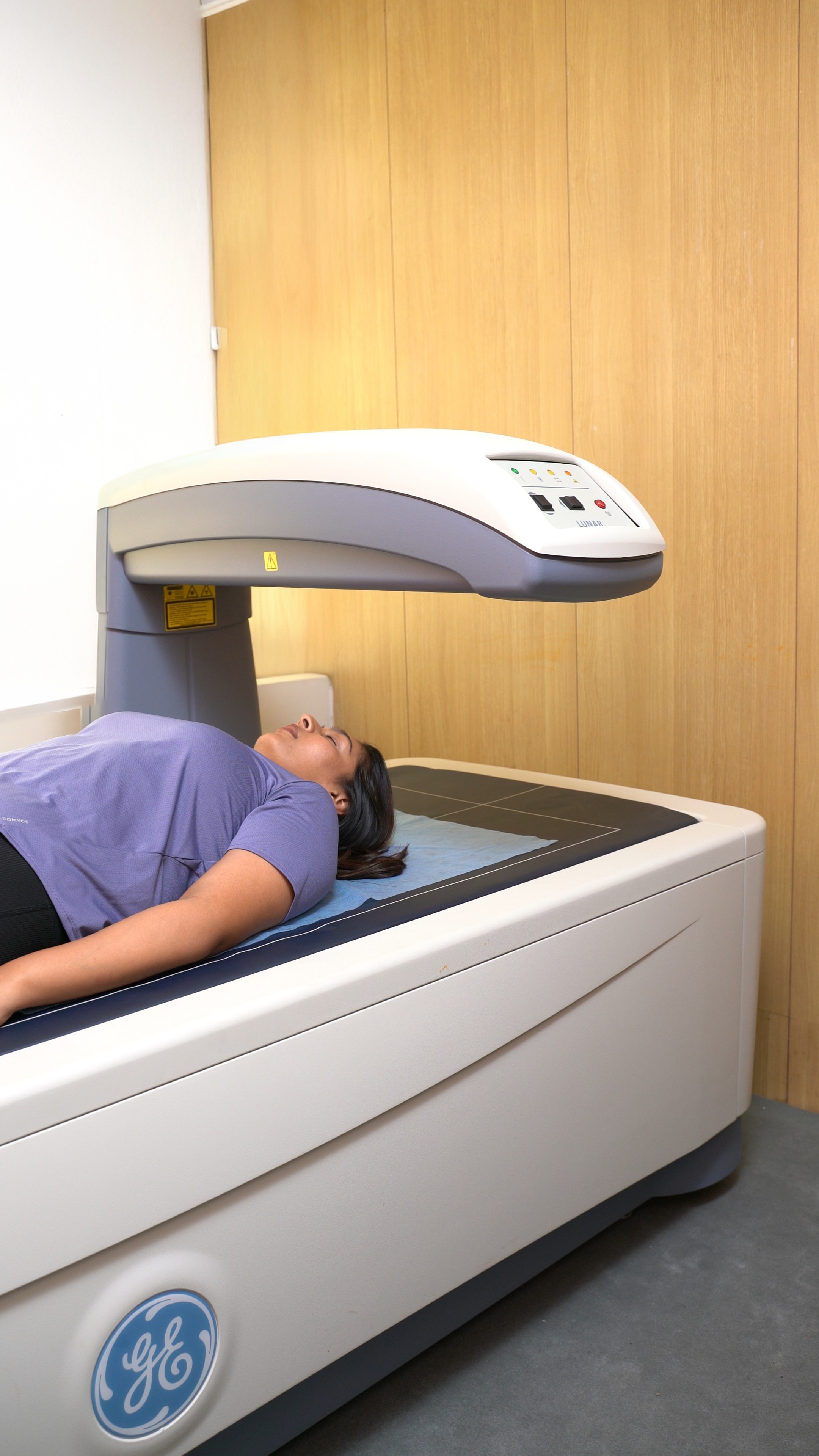
A DEXA scan measures fat, lean mass and bone density, and it does so separately for each arm and each leg. Combined with the strength tests, that allows two things no strength test can do alone.
The first is muscle quality: how much force you produce for each kilogram of lean mass. Two people with the same amount of muscle can produce very different force, and force per kilogram tells you how well the muscle is working.
The second is telling apart two problems that look identical on a strength test. Suppose your left leg is 15% weaker than your right:
If DEXA shows the left leg also carries noticeably less lean mass, the problem is muscle size, and the plan needs to build muscle.
If lean mass is equal on both sides, the muscle is there but is not being fully used. That often follows pain or an old injury, and the answer lies in activation, movement retraining and sometimes a clinical assessment, not simply more load.
The two situations need different plans, and without DEXA you cannot tell which one you are in. One honest caveat: DEXA's lean mass includes water and other non-fat tissue, so it is an excellent guide to muscle but not a pure measure of it.

Most strength testing ends with a report. Ours ends with a plan and a date to measure again.
Step one: classify. Every result is judged three ways: against the norm for your age, sex and body weight, against your other side, and against the opposing muscle group. A difference only counts if it is larger than the minimal detectable change, the smallest difference a test can reliably separate from ordinary day-to-day variation. Every test has its own figure, and a smaller difference is treated as noise.
Step two: target. Each finding is translated into the muscle groups that need work.

Step three: prescribe. You receive a three-month training plan built around those targets and matched to your training background. The first month is set out in detail; months two and three progress from it. The loading follows established principles: heavier loads for fewer repetitions to build strength, two to three sessions a week per targeted muscle group, explosive movements with intent to move fast to improve rate of force development, and single-limb work starting with the weaker side.
Here is a point that surprises people. Strength testing cannot reliably predict who will get injured (more on that below), yet targeted exercise can reduce injuries. A 2019 analysis of 15 studies and 8,459 athletes found that programmes including the Nordic hamstring exercise roughly halved hamstring injuries, though a later re-analysis of the same data argued the effect is less certain than that headline. In a trial across 35 football teams, an adductor programme built around the Copenhagen adduction exercise cut groin problems by 41%. You do not need to predict an injury to make it less likely. You need to find the weakness and train it.
Step four: retest. The body adapts in stages. In the first few weeks, most strength gained comes from the nervous system learning to recruit muscle better; growth of the muscle itself contributes more over the following months. Retesting too early shows only part of the change, and an early DEXA risks mistaking normal measurement variation for progress. So we retest at the end of the three-month plan, count a change as real only when it beats the minimal detectable change for that test, and use the retest as your new baseline.
If a result does not improve after two rounds of targeted work, we do not simply repeat the plan. We refer you to the right specialist, because a deficit that will not respond to training may have a cause training cannot fix.
It does not predict whether you will be injured, and we will not claim it does. In a study of 614 professional footballers, strength testing was barely better than chance at identifying who would strain a hamstring. A small study in professional ice hockey found that players whose adductor strength was below 80% of their abductor strength were far more likely to suffer groin strains. But one small study in one sport should not be stretched into forecasts for individuals.
It is not a diagnosis. A low reading tells us a muscle produces less force than expected. It does not tell us whether the cause is disuse, pain, an old injury, a nerve problem or an illness elsewhere in the body. That is a medical question, and the test informs it rather than answers it.
Like every measurement, it has limits. Handheld dynamometry can be affected by the tester's own strength when testing very strong people, which is why positioning and fixation are standardised. Comparisons are only as good as the reference data behind them. Both are reasons to test carefully, not reasons not to test.
What the protocol does give you is a trustworthy baseline, a clear picture of which weaknesses can be changed, a plan aimed directly at them, and a way of proving whether that plan worked. That is a more modest promise than much of the fitness industry makes. It is also one we can keep.


This article is for education and does not replace individual medical advice. All figures are original and drawn from the results reported in the cited studies.
Leong DP, et al. Prognostic value of grip strength: findings from the Prospective Urban Rural Epidemiology (PURE) study. Lancet. 2015;386(9990):266–273.
Angelozzi M, et al. Rate of force development as an adjunctive outcome measure for return-to-sport criteria after anterior cruciate ligament reconstruction. J Orthop Sports Phys Ther. 2012;42(9):772–780.
Gathercole R, et al. Alternative countermovement-jump analysis to quantify acute neuromuscular fatigue. Int J Sports Physiol Perform. 2015;10(1):84–92.
Comfort P, et al. Standardization and methodological considerations for the isometric mid-thigh pull. Strength Cond J. 2019;41(2):57–79.
Tyler TF, et al. The association of hip strength and flexibility with the incidence of adductor muscle strains in professional ice hockey players. Am J Sports Med. 2001;29(2):124–128.
van Dyk N, et al. Hamstring and quadriceps isokinetic strength deficits are weak risk factors for hamstring strain injuries. Am J Sports Med. 2016;44(7):1789–1795.
van Dyk N, et al. Including the Nordic hamstring exercise in injury prevention programmes halves the rate of hamstring injuries: a systematic review and meta-analysis of 8459 athletes. Br J Sports Med. 2019;53(21):1362–1370.
Impellizzeri FM, et al. Why methods matter in a meta-analysis: a reappraisal showed inconclusive injury preventive effect of Nordic hamstring exercise. J Clin Epidemiol. 2021.
Harøy J, et al. The Adductor Strengthening Programme prevents groin problems among male football players: a cluster-randomised controlled trial. Br J Sports Med. 2019;53(3):150–157.
American College of Sports Medicine. Progression models in resistance training for healthy adults. Med Sci Sports Exerc. 2009;41(3):687–708.
Moritani T, deVries HA. Neural factors versus hypertrophy in the time course of muscle strength gain. Am J Phys Med. 1979;58(3):115–130.
Other Blogs

DEXA Scan : Benefits, Uses & What It Measures

