GLP-1 Drugs: What the Weighing Scale Cannot See
GLP-1 drugs protect the heart and kidneys in ways weight loss can't explain. What the trials show, and why you should measure what you lose.

Every time you eat, cells lining the far end of your small intestine and your colon release a hormone called glucagon-like peptide-1, or GLP-1. It belongs to a family of gut hormones called incretins, whose job is to tell the rest of the body that food has arrived. Your own GLP-1 does that job very briefly: an enzyme called DPP-4 breaks it down within about two minutes.
The medicines that made this hormone famous are versions of that signal built to last. They include semaglutide (Ozempic and Wegovy), tirzepatide (Mounjaro) and orforglipron (Foundayo), a tablet approved in the US in April 2026. Semaglutide stays active for about a week. That one change, from two minutes to seven days, turned a brief after-meal message into one of the most important classes of medicine of our time.
GLP-1 has four well-established effects. Each one explains something people notice when they start these drugs.
It releases insulin, but only when blood sugar is high. Doctors call this glucose-dependent. It is why these drugs, used on their own, rarely push blood sugar dangerously low.
It switches off glucagon, the hormone that tells the liver to release stored sugar.
It slows how fast the stomach empties, so meals stay with you longer and sugar enters the blood more gradually.
It acts on the appetite centres of the brain, the hypothalamus and brainstem, reducing both hunger and the pull food has on attention. Two of those brainstem areas sit outside the blood-brain barrier, which is part of why a drug in the bloodstream reaches them so easily.


One more fact matters for the rest of this story. GLP-1 receptors are not only in the gut and pancreas. They are in the heart, blood vessels, kidneys, lungs, the brain's reward circuits, and a small structure called the choroid plexus, which makes the fluid around the brain and spinal cord. A drug that reaches that many tissues has many possible ways to act.
The common assumption is simple: these drugs protect the heart, liver and kidneys because people lose weight. Sometimes that is exactly right.
Sleep apnoea fits the weight story. Severity is measured by the apnoea-hypopnoea index (AHI), the number of times per hour of sleep that breathing stops or drops sharply. In the SURMOUNT-OSA trials, tirzepatide cut body weight by 18 to 20% and the AHI by 51 to 59%. Pooled studies of every kind of weight loss, including surgery and diet, show that losing 20% of body weight typically cuts the AHI by about 57%. The drug lands almost exactly where weight loss alone would put it.
The heart does not. The SELECT trial followed 17,604 people with existing heart disease and excess weight, none with diabetes. Over about three and a half years, semaglutide reduced heart attacks, strokes and cardiovascular deaths by 20%. People whose blood sugar improved most were not better protected, and neither, clearly, were those who lost the most weight. A smaller waist tracked with lower risk, but even waist size explained only about a third of the benefit.
Weight and blood sugar are surrogate markers: easy measurements we follow because we assume they move in step with the outcome we care about. In the largest heart trial of these drugs, the two surrogates every clinic measures explain only a minority of what happened.
The kidneys push this further. In the FLOW trial, semaglutide cut kidney failure, serious loss of kidney function and death from kidney or heart causes by 24%. Yet people on the drug lost only about 4 kg more than those on placebo. Everyone in FLOW already had kidney disease. An earlier analysis found that in healthier kidneys, better sugar control explained around 57% of the protection; in damaged kidneys, the best estimate for what sugar or weight explained was zero. The protection was still there.
Then there is the brain. Idiopathic intracranial hypertension is a condition in which pressure builds inside the skull and threatens vision. In a small trial, 15 women had pressure monitors implanted and received either exenatide, an older GLP-1 drug, or placebo. Pressure was lower on the drug two and a half hours after the first dose, and still lower at twelve weeks, when weight had barely changed. The trial is tiny. But nobody loses weight in two and a half hours. The leading explanation is the choroid plexus: lab studies suggest that activating its GLP-1 receptors reduces how much fluid it makes, though this is not yet proven in humans.
The most unexpected finding concerns alcohol. Two randomised trials now show that semaglutide reduces drinking. In the larger one, SEMALCO (108 adults with alcohol use disorder and obesity, The Lancet, 2026), heavy-drinking days fell from about 17 a month to about 5 on semaglutide, against about 9 on placebo. Both groups also received therapy; the drug added a 13.7 percentage-point drop on top. Everyone in SEMALCO had obesity, so weight loss cannot be fully ruled out there. A smaller 2025 trial in JAMA Psychiatry, which did not require obesity, also found reduced drinking and craving.
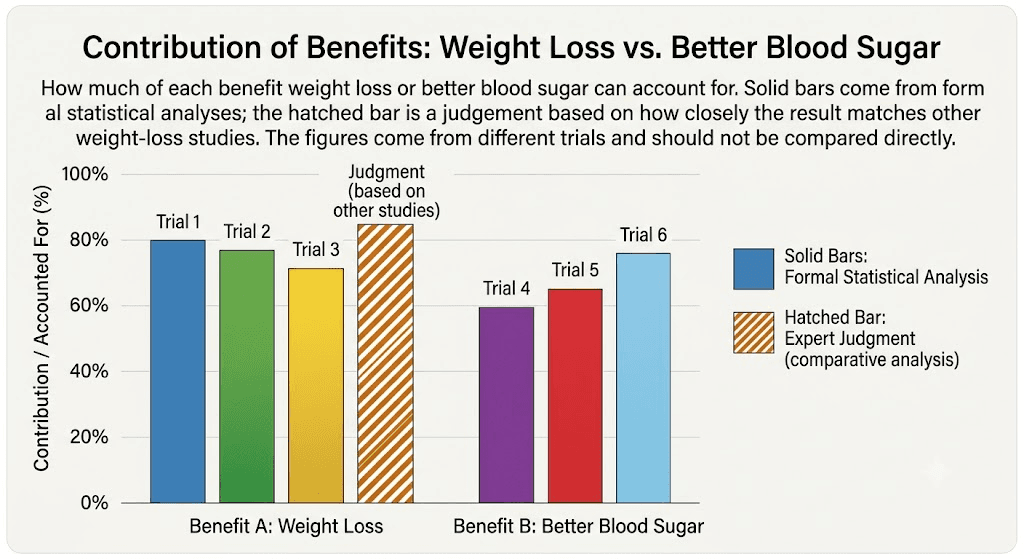
None of this means these drugs have one secret mechanism. It means the numbers we routinely check do not fully explain what the drugs do. And the further a disease sits from excess fat, the wider that gap becomes.

This is the question that matters most to an individual and is asked least often. When someone loses 15 kg, some of it is fat and some is lean mass: muscle, organ tissue, water, everything that is neither fat nor bone. Studies estimate that 15% to 40% of the weight lost on these drugs is lean mass, depending on who is studied and how. A weighing scale cannot tell the difference. A DEXA scan can.
The most informative trial so far is BELIEVE, published this year in Nature Medicine. Its 507 participants received semaglutide, a second drug called bimagrumab, or both. Bimagrumab blocks the activin receptor, part of a signalling system that normally limits how much muscle the body builds.


Semaglutide alone: 15.7% of body weight lost, and 7.4% of lean mass.
Bimagrumab alone: 10.8% of body weight lost, with lean mass up 2.5%.
Both together: 22.1% of body weight lost, including nearly half of total body fat and more than half of deep abdominal fat, while lean mass fell only 2.9%.
It is a striking result with one important limit. BELIEVE measured muscle mass, not muscle function. It did not report whether people were stronger, walked faster or fell less. Keeping muscle on a scan is a reasonable sign that strength is protected. It is not proof.
The little functional data that exists complicates the worry. The SEMALEAN study followed 106 patients on semaglutide for a year with no comparison group. Hand grip strength rose by roughly 4 kg, and the share of patients with sarcopenic obesity, excess fat combined with weak or insufficient muscle, fell from 49% to 33%. Two caveats: these patients had severe obesity (average BMI 46), and people who start these drugs often start exercising too. Still, it points the opposite way from the headlines.
The fair conclusion is narrower than either side of the public debate. Lean mass does fall on semaglutide alone, by an amount that is measurable and not trivial. Whether that makes a particular person weaker is not yet known, and the only way to find out is to measure both body composition and strength. The international definition of sarcopenia now puts muscle strength first and muscle size second. Strength is exactly what the drug trials have not reported.
SURMOUNT-MAINTAIN, published in The Lancet in May 2026, took 378 people who had already lost weight on tirzepatide and split them three ways for another year: stay on the full dose, drop to a low 5 mg dose, or switch to placebo.
Full dose: kept essentially all of the weight off. Only 8% regained half or more of what they had lost.
5 mg dose: kept about 70% of the loss off. 25% regained half or more.
Placebo: 67% regained half or more.
A companion trial showed people could move from injections to the orforglipron tablet and keep most of their loss.
The message is plain and rarely said at the start: for most people these are long-term medicines, much like blood pressure tablets. A lower dose is a real option, but it holds less. In India, where most people pay for treatment themselves, that belongs in the first conversation, not the one eighteen months later.
The most useful approach is to treat the scan as a baseline and then compare future results to understand how your body is changing.
A tablet with no food rules. The US approved orforglipron on 1 April 2026. At its highest dose it produced 12.4% weight loss over 72 weeks, against 0.9% on placebo. That is less than the injections, but a once-daily tablet with no fasting window could matter enormously for access in a country like ours.
Bigger numbers. In May 2026, Eli Lilly reported that retatrutide produced 28.3% weight loss at 80 weeks in the TRIUMPH-1 trial (2,339 people), against 2.2% on placebo. That figure counts people who stayed on treatment, and it is a company announcement, not yet a peer-reviewed paper. It approaches what bariatric surgery achieves.
Combinations. CagriSema, which pairs semaglutide with a long-acting version of amylin, a hormone involved in fullness after meals, produced about 20% weight loss in the REDEFINE-1 trial, and about 23% in people who took it as prescribed.
Muscle-sparing therapy. BELIEVE showed for the first time in a randomised trial that how much weight is lost and what kind of tissue is lost can be controlled separately.
Some things are settled. These drugs produce more weight loss than any medicine before them, improve blood sugar substantially, and have reduced heart attacks, kidney failure and deaths in large randomised trials. That is the strongest kind of evidence medicine has.
Other things are not settled, and they deserve equal airtime.
We do not fully know why they work in the heart and kidneys, so weight and sugar readings cannot tell you how well a particular person is protected.
Lean mass falls on semaglutide alone, and the trials have not yet shown what that does to strength and function.
The weight returns when the drug stops. That is why maintenance trials exist.
Side effects are common. In REDEFINE-1, 80% of people on the drug had stomach or bowel symptoms, against 40% on placebo. Gallbladder problems are a recognised risk and pancreatitis a rare one.
Bone has been studied too little. Rapid weight loss lowers bone density, and long-term fracture data is limited.
Almost everyone studied had obesity, diabetes or a clear metabolic problem. There is very little evidence in lean, healthy people, who are exactly the people now taking small doses "for longevity". No trial supports that practice.
If the argument above holds, what gets measured matters as much as what gets prescribed. This is what sensible monitoring looks like.

The advice with the best evidence is not glamorous: resistance training two to three times a week, and 1.2 to 1.6 g of protein per kilogram of body weight each day. In the S-LITE trial, people who combined a GLP-1 drug with supervised exercise kept their weight off and improved body composition more than people who used either one alone.
For someone with excess weight and heart disease, kidney disease, sleep apnoea or fatty liver disease, the evidence for treatment is strong. For a healthy adult hoping to live longer, it is still speculation. And for anyone on these drugs, losing a fifth of your body weight without knowing what tissue it came from is an incomplete result.

The advice with the best evidence is not glamorous: resistance training two to three times a week, and 1.2 to 1.6 g of protein per kilogram of body weight each day. In the S-LITE trial, people who combined a GLP-1 drug with supervised exercise kept their weight off and improved body composition more than people who used either one alone.

This article is for education and does not replace individual medical advice. All figures are original and drawn from the results reported in the cited studies.
The advice with the best evidence is not glamorous: resistance training two to three times a week, and 1.2 to 1.6 g of protein per kilogram of body weight each day. In the S-LITE trial, people who combined a GLP-1 drug with supervised exercise kept their weight off and improved body composition more than people who used either one alone.
Lincoff AM, et al. Semaglutide and cardiovascular outcomes in obesity without diabetes (SELECT). N Engl J Med. 2023;389(24):2221–2232.
Deanfield J, et al. Semaglutide and cardiovascular outcomes by baseline and changes in adiposity measurements: a prespecified analysis of the SELECT trial. Lancet. 2025;406(10516):2257–2268.
Lingvay I, et al. Semaglutide and cardiovascular outcomes by baseline HbA1c and change in HbA1c in SELECT. Diabetes Care. 2024;47(8):1360–1369.
Perkovic V, et al. Effects of semaglutide on chronic kidney disease in patients with type 2 diabetes (FLOW). N Engl J Med. 2024;391(2):109–121.
Mann JFE, et al. Potential kidney protection with liraglutide and semaglutide: exploratory mediation analysis. Diabetes Obes Metab. 2021;23(9):2058–2066.
Malhotra A, et al. Tirzepatide for the treatment of obstructive sleep apnea and obesity (SURMOUNT-OSA). N Engl J Med. 2024;391(13):1193–1205.
Malhotra A, et al. Weight reduction and the impact on apnea-hypopnea index: a systematic meta-analysis. Sleep Med. 2024;121:26–31.
Sanyal AJ, et al. Phase 3 trial of semaglutide in metabolic dysfunction-associated steatohepatitis (ESSENCE). N Engl J Med. 2025;392(21):2089–2099.
Mitchell JL, et al. The effect of GLP-1RA exenatide on idiopathic intracranial hypertension: a randomized clinical trial. Brain. 2023;146(5):1821–1830.
Klausen MK, et al. Once-weekly semaglutide versus placebo in patients with alcohol use disorder and comorbid obesity (SEMALCO). Lancet. 2026;407(10540):1687–1698.
Hendershot CS, et al. Once-weekly semaglutide in adults with alcohol use disorder: a randomized clinical trial. JAMA Psychiatry. 2025.
Bimagrumab plus semaglutide alone or in combination for the treatment of obesity: a randomized phase 2 trial (BELIEVE, NCT05616013). Nat Med. 2026.
Alissou M, et al. Impact of semaglutide on fat mass, lean mass and muscle function in patients with obesity: the SEMALEAN study. Diabetes Obes Metab. 2025.
Horn DB, et al. Tirzepatide for maintenance of bodyweight reduction in people with obesity in the USA (SURMOUNT-MAINTAIN). Lancet. 2026;407(10545):2305–2318.
US Food and Drug Administration. FDA approves first new molecular entity under National Priority Voucher Program (orforglipron). Press release, 1 April 2026.
Eli Lilly and Company. Retatrutide TRIUMPH-1 topline results. Press release, 21 May 2026.
Lundgren JR, et al. Healthy weight loss maintenance with exercise, liraglutide, or both combined (S-LITE). N Engl J Med. 2021;384(18):1719–1730.
Cruz-Jentoft AJ, et al. Sarcopenia: revised European consensus on definition and diagnosis. Age Ageing. 2019;48(1):16–31.
Other Blogs

Strength Testing in Chennai: The Vital Insights Protocol

